
AI wearables are slowly becoming normal tools for everyday health awareness, not only for sport freaks or tech fans. They help people follow heart rate, movement and other vital signs in a more continuous and context-aware way. The goal is not perfect medical data but simple feedback for daily decisions. This article looks at how these devices support health in daily life and where their limits are.
Everyday Role Of AI wearables In Vital Monitoring
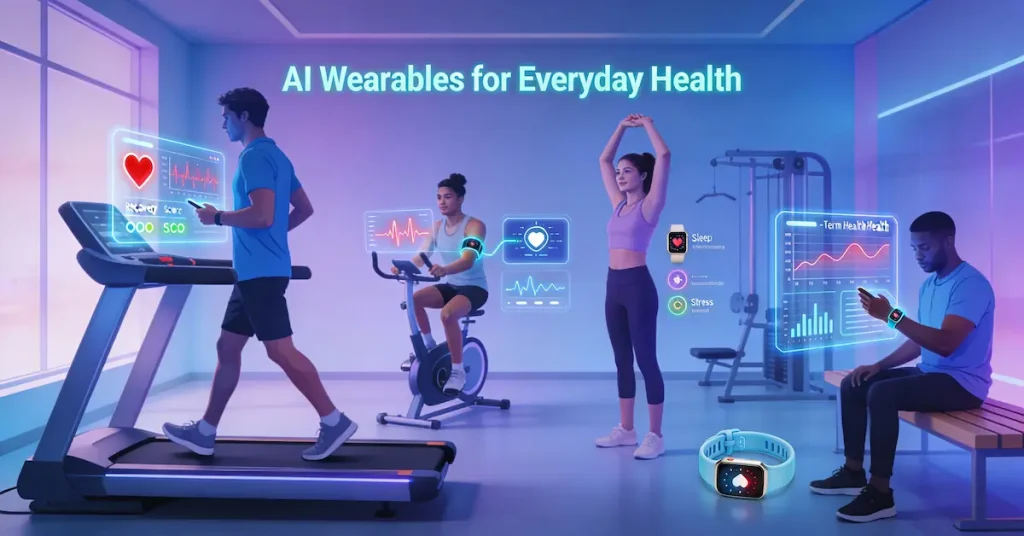
In health & vital monitoring, AI devices sit between simple fitness gadgets and professional medical tools and try to make trends visible over days, weeks and months. They collect signals like heart rate, steps, sleep, skin temperature or movement and use models to turn them into easy summaries. Users do not have to read raw graphs all the time; they get short messages such as “recovery looks low today” or “your resting heart rate is higher than usual”. This kind of feedback helps people connect body signals to daily habits, for example stress, sleep or alcohol. Many devices also support gentle habit building, like walking more, going to bed earlier or taking more breaks. At the same time, they stay consumer products and should be seen as helpers, not as diagnostic systems.
What Health Signals Smart Wearables Track
In this section, everyday health wearables are mostly focused on basic, robust signals that are easy to measure on the wrist, finger or skin. Typical metrics include heart rate, resting heart rate, activity level, sleep duration, estimated sleep stages, skin temperature changes and sometimes blood oxygen. Some devices also estimate heart rate variability as a proxy for recovery and stress, even if these values are not as precise as clinical tools. Over time, learning models compare today’s values with a personal baseline and highlight deviations. This approach is often more useful than only looking at general normal ranges, because it respects that every body is different. For everyday use, the main value lies in seeing patterns around lack of sleep, long sitting, intense training or periods of high pressure.
The most common signals can be grouped into heart and circulation, activity, sleep and basic temperature or oxygen trends. Each group has different strengths and weaknesses when used at home without clinical supervision. The table below gives a simple overview that helps set expectations for daily use.
| Metric Type | Example Signals | Everyday Use Case | Notes On Reliability |
|---|---|---|---|
| Heart & circulation | Heart rate, resting rate | Cardio load and fitness trend | Good for trends, not diagnosis |
| Activity & movement | Steps, intensity minutes | Sedentary time and daily movement | Fairly robust in normal use |
| Sleep & recovery | Sleep duration, HRV trend | Recovery, fatigue, routine checks | Estimates, not clinical data |
| Temperature & SpO2 | Skin temp, oxygen level | Rough changes, illness awareness | Sensitive to wearing conditions |
Practical Use Cases At Home
In this section, AI wearables are seen as tools that support small daily decisions instead of promising big life changes. In everyday life, watches and rings can gently nudge a person to move after long sitting, drink water during long meetings or slow down training when effort looks high for several days in a row. Sleep-related insights often help users see how late screen time, alcohol or very late dinners affect night rest and next-day energy. Some devices offer stress or readiness scores that combine different signals into one simple number, which is easier to follow than many separate metrics. For people with busy lives, this condensed feedback can lower the mental load of self-tracking and still keep an eye on basics such as rest, movement and recovery. At the same time, it remains important that people understand these scores as support for self-reflection, not as absolute truth about their health state.
Everyday scenarios show best how these devices fit into normal routines. The examples below are simple, but they illustrate where continuous feedback can really help. Readers can map them to their own habits and decide which signals matter most.
- Gentle reminders to stand up and walk a bit
- Simple feedback after very intense training days
- Sleep pattern overview over several weeks
- Signals when resting heart rate changes slowly
- Hints when daily routines drift away from baseline
Deep Dive: Everyday Health Monitoring Clusters
In this section, everyday health monitoring is connected with related guides on your site so readers can explore specific angles in more depth. The goal is to group daily health topics into clear clusters that match real questions: basics, form factors, mental well-being and concrete use cases. Each subsection gives a short overview and then links to detailed articles for further reading.
Everyday Health Monitoring Basics
This subsection looks at general questions around how devices support everyday health monitoring over time. It covers how continuous tracking of activity, sleep and simple vital signals helps people see trends instead of isolated numbers. Readers who want a broad, beginner-friendly view of health monitoring with smart wearables can use these guides as a starting point.
- How AI Wearables Are Used for Health Monitoring
- AI Wearables For Everyday Health
- AI Wearables: Practical Use, Devices & Real-World Applications
- AI Wearables And The New Era Of Remote Coaching In India
- AI Wearables In Rural Remote Healthcare
- Oura Ring 4 – Privacy and Data Use Explained
Form Factors For Vital And Recovery Data
This subsection focuses on how different device types handle health and recovery data in daily life. Rings, patches and bandage-style wearables each bring their own trade-offs in comfort, battery life and signal quality. Readers can learn when it makes sense to use a subtle plaster, a ring for sleep and recovery or a more visible device with stronger real-time feedback.
- AI wearable patch as everyday health helper
- AI Wearable Ring Advantages vs. Smartwatches
- Wearable AI Bandage Guide for Smarter Everyday Care
- AI Smart Rings Explained: When a Ring Makes More Sense Than a Watch
- What to Expect From an AI Wearable Headband Today
- AI Wearables: Which Oura Ring Is Best For You
Health, Stress And Mental Well-Being
This subsection shows how continuous body signals connect with stress, mood and mental well-being in everyday life. Metrics like heart rate variability, sleep quality and activity trends can give gentle hints when tension builds up or routines slip. The linked articles go into more detail on how people use these signals for mindfulness, emotional balance and daily mental health support.
- AI Wearables for Mental Health
- AI Wearables for Mindfulness – Smart Tech for Emotional Well-Being
- AI Wearable for Mental Health – Better Daily Balance
- AI Wearables for Stress and Focus: Real Help or Just Data?
Coaching
AI-powered wearables are becoming valuable tools in mental coaching, offering real-time insights into emotional states and stress levels. By tracking biometric data like heart rate variability and sleep quality, these devices help coaches personalize strategies for improved focus, resilience, and overall well-being.
- AI Wearables In Health & Vital Monitoring
- AI Wearables in Coaching: The 7 Most Important Metrics
- AI Wearables And The New Era Of Remote Coaching In India
- The Impact Of AI Wearables On Modern Coaching Practices
Use Cases And Comparisons Around Everyday Health
This subsection brings together broader use cases and comparison hubs that also touch health-related monitoring. It highlights how fitness, performance and general use case overviews connect with vital and recovery data in practice. Readers who want to compare devices or see concrete sport-related health scenarios will find good entry points here.
- AI Wearables for Fitness Training: What Really Helps in Daily Life
- AI Wearable Use Cases
- AI Wearable Comparisons
When Everyday Health Wearables Reach Their Limits
In this section, limitations of home health monitoring devices are described so users keep realistic expectations. First, measurements are influenced by sensor quality, skin contact, movement, tattoos, sweat and many other factors, so they are naturally noisy. Accuracy can also vary strongly between brands and between individuals, especially for heart rate variability and sleep stages. Second, devices often lack full context: they might see high heart rate but cannot always know if it is from coffee, stress, stairs or emotion. Third, battery life and comfort set limits, because people sometimes remove devices exactly when long-term data would be most interesting, for example during sleep or travel. Finally, these tools are not meant to diagnose or treat diseases on their own, so they should never replace professional care when something feels wrong.
Why “Trends, Not Diagnosis” Matters
This subsection explains why everyday health monitoring should focus on trends instead of big health statements. Over days and weeks, even imperfect data can show that sleep is getting shorter, resting heart rate is slowly climbing or recovery seems lower than usual. This early awareness can motivate a person to rest more, talk to a doctor sooner or adjust habits before problems grow.
Balancing Feedback And Stress
This subsection looks at the emotional side of continuous feedback from wearables. For some people, seeing metrics every day becomes stressful or leads to constant checking. In these situations, it can help to reduce notifications, stop looking at numbers during the day and focus only on simple weekly summaries.
Choosing The Right Device For Everyday Health
In this section, the focus is on practical selection criteria for daily health use at home. For mainly sleep and recovery, a comfortable ring or headband that works well overnight may be more useful than a bright smartwatch screen. For activity focus, a wrist device with clear workout modes, good heart rate tracking and simple summaries after runs or gym sessions makes more sense. People who travel a lot or forget to charge devices might prefer wearables with long battery life and fewer functions instead of complex gadgets that need daily charging. Finally, the companion app is as important as the hardware, because it controls how data is shown, which insights appear and how easy it is to see long-term trends.
Frequently Asked Questions
Can These Devices Warn Me If My Vital Signs Are Dangerous?
Consumer devices can sometimes alert you to unusual patterns like very high heart rate or irregular rhythms, but these alerts are limited and not a full safety system. If something feels wrong or an alert looks serious, it is always better to contact a medical professional than to rely only on the wearable.
How Often Should I Check Health Data From My Device?
For most people, looking at daily summaries and weekly trends is enough, especially for sleep, activity and resting heart rate. Constant checking during the day can create stress, so it is usually better to focus on patterns and habits than on every single data point.
Are Rings Or Smartwatches Better For Health & Vital Monitoring?
Rings are often more comfortable at night and good for sleep and recovery trends, while smartwatches are better for workouts and real-time feedback during the day. The best choice depends on whether you care more about quiet background tracking or active interaction with your device.
Final Thoughts
In daily life, AI wearables for health and vital monitoring work best as quiet partners that help people see how lifestyle, sleep and stress shape their body over time. They turn noisy sensor data into simple patterns that support small, realistic changes instead of promising dramatic health transformations. At the same time, they remain imperfect tools with limited accuracy and context, so a critical, relaxed mindset is always healthy. When used with clear expectations, these devices can be a useful extra layer of awareness at home and a natural cluster next to broader guides on intelligent wearables.
Sources
Nature
A Continuous Real-World Dataset Comprising Wearable-Derived Health Signals (2025)
National Institutes of Health / PMC
Smart Healthcare at Home: A Review of AI-Enabled Technologies (2025)
Oxford Academic – European Heart Journal Digital Health
Smartwatch-Derived Heart Rate Variability: A Head-to-Head Comparison With ECG (2023)
ScienceDirect
Overview of the Future Impact of Wearables and Artificial Intelligence in Health Monitoring (2024)


